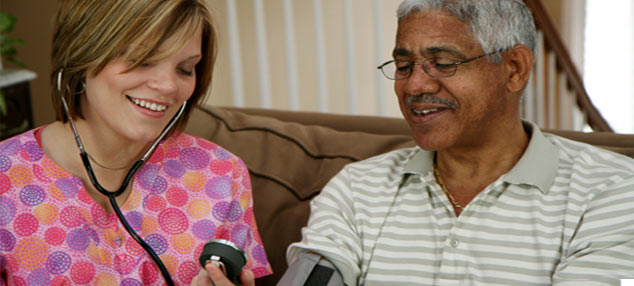

Home healthcare services are available for patients who are homebound and require skilled nursing or rehabilitative care. Many healthcare treatments that were once only offered in a hospital or a physician's office can now be safely, effectively, and efficiently provided in patients' homes by skilled clinicians. Home healthcare is generally less expensive, more convenient, and as effective as care provided in institutional settings.
In 2010, approximately 3.5 million Medicare beneficiaries received home healthcare services.
In 2010, more than 500,000 registered nurses, licensed practical nurses, home healthcare aides, and other practitioners provided home healthcare to patients.
Home healthcare can serve as an intermediate level of care for patients who have difficulty accessing outpatient care or who need intensive assistance with an acute or chronic health problem. For example, Medicare beneficiaries returning home after a hospitalization often receive home healthcare to assist them with the transition.
Analysis demonstrates that the skilled home healthcare profession has the experience, structure, technology, and transparency best suited to meet patients' chronic disease management needs.
According to MedPAC, skilled home healthcare visits permit beneficiaries to shorten or avoid post-acute stays at skilled nursing facilities and other higher cost post-acute care settings.
Home healthcare helps patients avoid the inherent risks of hospitalization including infection, delirium, depression, infection and functional decline. Studies show older people, particularly the frail and elderly, have a 23.3 percent risk of being unable to return home after even a very short hospitalization and require nursing home placement.
Home healthcare patients are among the poorest, sickest and most vulnerable beneficiaries in the Medicare program. Quality home healthcare services allow these patients to remain in their homes and receive necessary skilled nursing and therapy services, while avoiding unnecessary inpatient care and hospital stays.
More than half of these beneficiaries have an annual income below $21,780.
This group has a 25 percent higher rate of poverty than the typical Medicare beneficiary.
28 percent of these patients are over the age of 85 (compared to 11 percent among Medicare as a whole).
36 percent live alone (compared to 31 percent among Medicare as a whole).
86 percent have three or more chronic conditions (compared to 68 percent of Medicare as a whole).
Almost 19 percent have two or more Activities of Daily Living (ADL) limitations (compared to 5.8 percent of Medicare as a whole).
Approximately 46 percent report being in fair to poor health (compared to 26 percent of Medicare as a whole).
40 percent are in "somewhat worse" or "much worse" health than last year (compared to 23 percent of Medicare as a whole).
78 percent of Medicare's home healthcare patients are non dual-eligible patients, and are not covered by Medigap insurance.
According to an analysis of the Medicare Payment Advisory Commission's data presented in the March 2011 Report to Congress, home healthcare is less expensive than care provided in institutional settings. Skilled home healthcare is regarded as highly cost effective, offering patients clinically advanced care in the setting they prefer.
Home healthcare has proven to be highly effective for providing comprehensive primary care and reducing healthcare costs. For example, the U.S. Department of Veterans Affairs (VA) established Home Based Primary Care (HBPC) in response to the anticipated growth of the veteran population with chronic disabling diseases. Through this program, the VA has provided comprehensive primary care services to veterans in their homes since 1972.
The program has proven to be highly effective in reducing preventable emergency room visits and inpatient hospital days.
The program was specifically designed to target patients with complex chronic diseases through an interdisciplinary team of health professionals.
HBPC achieved reductions in inpatient hospital days by 62 percent and nursing home days by 88 percent, resulting in a 24 percent decrease in total healthcare costs.
The VA HBPC has been characterized as "a model to emulate for the care of persons with complex, chronic disabling conditions, improving quality without added cost, and maximizing their independence through comprehensive longitudinal interdisciplinary care delivered in their homes."
America's population is aging rapidly, creating greater need for skilled home healthcare services among our nation's seniors. As the most cost effective, clinically skilled setting available, home healthcare can meet the care needs of a diverse senior population and reduce America's healthcare costs.
Every 13 seconds, another American turns 65 years old. That trend will continue for the next 20 years.
There are 40.4 million seniors in the U.S., 12 percent of the population. In 20 years, that number will total 70 million, or 20 percent of the population.
More than 27 million of these individuals are over age 70, and more that 1 million are over age 80.
More than 43 million people in the U.S., 19 percent of the population, provide care for an elderly family member or friend.
Program integrity and payment reforms are needed to strengthen the Medicare and Medicaid programs and secure seniors' access to quality healthcare services. With regard to home healthcare, the Medicare Payment Advisory Commission (MedPAC) has identified 25 counties as having the highest prevalence of Medicare abuse in home healthcare.
The MedPAC data demonstrate that program integrity is a targeted problem. In response, the home healthcare community has developed bold reforms that offer a targeted solution.
Learn how the MedPAC-25 counties compare to your state
Get the Facts
Find out how home healthcare is meeting seniors' needs and reducing America's healthcare costs.